
In today’s competitive business landscape, sales and marketing teams cannot afford to work in silos. Customers interact with brands across multiple touchpoints—websites, emails, ads, social media, and sales calls. Managing these interactions without a centralized system often leads to missed opportunities, poor coordination, and lost revenue.
This is where a CRM (Customer Relationship Management) system delivers real value. A CRM helps sales and marketing teams work together using shared data, streamline workflows, and create personalized customer experiences that drive growth.
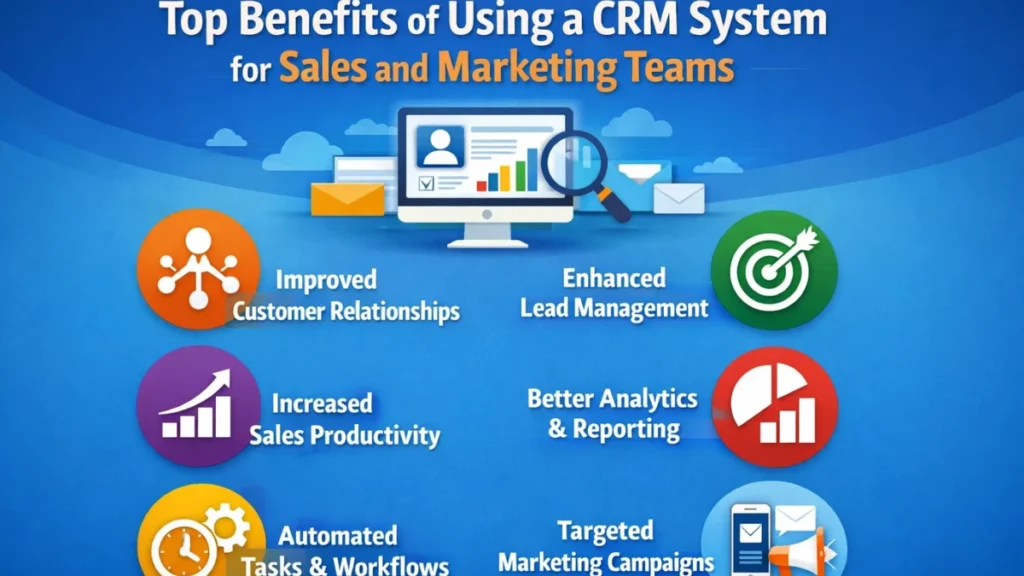
This article explores the top benefits of using a CRM system for sales and marketing teams and why it has become an essential business tool.
Centralized Customer Data for Both Teams
One of the biggest advantages of a CRM system is centralized data access.
Single Source of Truth
A CRM stores all customer information in one place, including:
- Contact details
- Lead sources
- Interaction history
- Purchase records
- Engagement behavior
Both sales and marketing teams access the same up-to-date information, eliminating confusion and duplication.
Better Data Accuracy
With automated data capture and updates, CRM systems reduce:
- Manual errors
- Duplicate records
- Outdated customer details
Accurate data leads to better decisions and stronger customer relationships.
Stronger Alignment Between Sales and Marketing
Shared Goals and Visibility
CRM systems help sales and marketing align by:
- Tracking lead progress
- Measuring campaign impact
- Sharing performance insights
Marketing teams see which campaigns generate quality leads, while sales teams understand lead intent before outreach.
Improved Lead Handover
CRM systems clearly define when a lead is:
- Marketing-qualified
- Sales-qualified
- Ready for follow-up
This reduces friction and improves conversion rates.
Improved Lead Management and Tracking
Capturing Leads from Multiple Channels
CRM systems automatically collect leads from:
- Websites and landing pages
- Email campaigns
- Social media ads
- Events and referrals
No lead is lost, and every inquiry is tracked in real time.
Lead Scoring and Prioritization
CRM tools score leads based on:
- Engagement level
- Website activity
- Communication responses
Sales teams focus on high-potential leads, saving time and effort.
Increased Sales Productivity
Automated Follow-Ups and Reminders
CRM systems automate:
- Follow-up emails
- Task reminders
- Call schedules
This ensures consistent communication and faster response times.
Reduced Administrative Work
By automating data entry and updates, CRM systems free sales teams to focus on:
- Relationship building
- Closing deals
- Upselling and cross-selling
Smarter Marketing Campaigns
Better Audience Segmentation
CRM systems allow marketers to segment audiences based on:
- Demographics
- Purchase history
- Engagement behavior
- Preferences
Targeted campaigns perform better than generic messaging.
Personalized Marketing at Scale
With CRM data, marketers can personalize:
- Email content
- Offers and promotions
- Campaign timing
Personalization improves engagement and brand loyalty.
Enhanced Sales Pipeline Visibility
Clear Funnel Overview
CRM systems provide visual sales pipelines showing:
- Deals at each stage
- Expected revenue
- Closing timelines
Managers can quickly identify bottlenecks and opportunities.
Accurate Sales Forecasting
Using historical data, CRM systems help predict:
- Revenue trends
- Conversion rates
- Team performance
This supports better planning and goal setting.
Better Customer Experience
Consistent Communication
CRM systems ensure customers receive:
- Relevant messages
- Timely responses
- Personalized interactions
Consistency builds trust and long-term loyalty.
Faster Issue Resolution
Support and sales teams can view:
- Past interactions
- Purchase history
- Previous concerns
This leads to quicker, more effective problem-solving.
Data-Driven Decision Making
Real-Time Reports and Dashboards
CRM analytics provide insights into:
- Campaign performance
- Sales effectiveness
- Customer behavior
Decisions are based on data, not assumptions.
Measuring ROI Effectively
CRM systems track:
- Lead-to-sale conversions
- Campaign attribution
- Revenue by channel
This helps justify marketing spend and optimize strategies.
Automation That Scales with Growth
Workflow Automation
CRM systems automate repetitive tasks such as:
- Lead assignment
- Status updates
- Notification alerts
Automation ensures processes remain efficient as the business grows.
Support for Larger Teams
As teams expand, CRM systems:
- Manage user roles
- Control data access
- Maintain process consistency
Scalability is built into modern CRM platforms.
Improved Collaboration Across Departments
Transparent Communication
CRM systems allow teams to:
- Share notes
- Track activity logs
- Collaborate on deals
This reduces misunderstandings and improves teamwork.
Unified Customer View
Everyone works from the same customer profile, ensuring a seamless experience across touchpoints.
Competitive Advantage in the Market
Businesses using CRM systems benefit from:
- Faster response times
- Better customer insights
- More personalized engagement
This creates a strong edge in crowded markets.
Common Challenges Without a CRM
Sales and marketing teams without a CRM often face:
- Lost leads
- Poor coordination
- Limited visibility into performance
- Inefficient workflows
A CRM system solves these challenges by bringing structure and clarity.
Conclusion
A CRM system is no longer just a sales tool—it is a strategic platform that connects sales and marketing teams. By centralizing data, improving collaboration, automating workflows, and delivering actionable insights, CRM systems drive efficiency and growth.
For businesses aiming to scale, improve customer experience, and maximize revenue, investing in a CRM system is not optional—it’s essential.
FAQs
How does a CRM help sales teams?
CRM systems help sales teams manage leads, track deals, automate follow-ups, and close more sales efficiently.
How does CRM benefit marketing teams?
CRM systems enable better targeting, personalization, campaign tracking, and ROI measurement.
Can small teams benefit from a CRM?
Yes, CRM systems help small teams stay organized, save time, and scale faster.
Does CRM improve collaboration?
Absolutely. CRM systems align sales and marketing by providing shared data and visibility.
Is CRM useful beyond sales and marketing?
Yes, CRM systems also support customer service, management, and business analytics.