
In a competitive business environment, tracking leads, managing customers, and monitoring sales efficiently can be the difference between growth and stagnation. When data is scattered across spreadsheets, emails, and different tools, teams lose visibility, miss follow-ups, and waste opportunities.
This is where a CRM (Customer Relationship Management) system becomes essential. A CRM brings leads, customers, and sales data into one centralized platform, helping businesses stay organized, make better decisions, and close more deals.
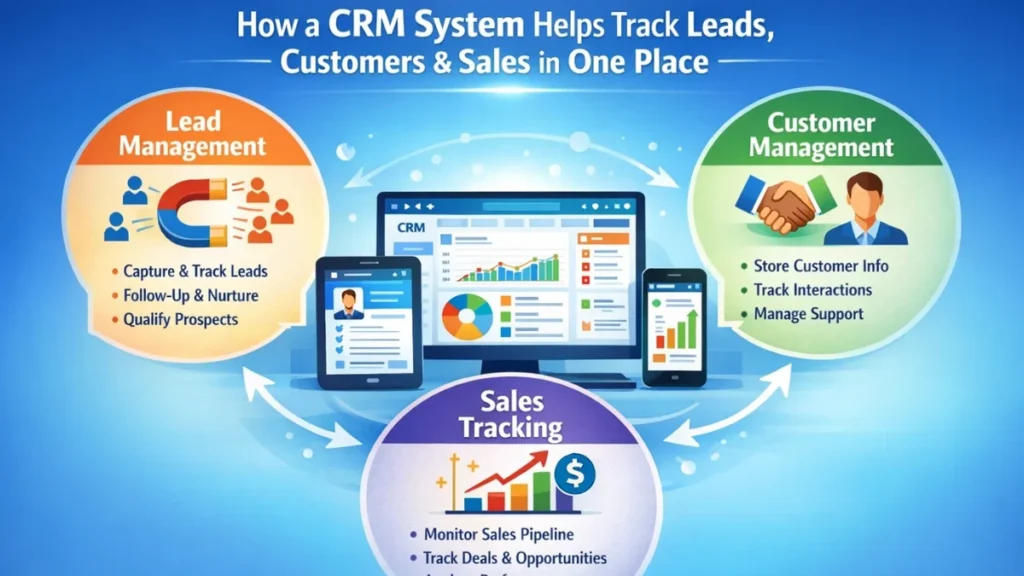
This article explains how a CRM system helps track leads, customers, and sales in one place and why it is a must-have tool for modern businesses.
What Is a CRM System?
A CRM system is software that helps businesses collect, store, and manage information related to prospects and customers. It tracks every interaction—from the first inquiry to the final sale and beyond.
CRM systems are widely used by:
- Sales teams
- Marketing teams
- Customer support teams
- Business managers
By sharing the same data, teams work more efficiently and provide a better customer experience.
Centralized Lead Tracking
Capturing Leads from Multiple Sources
A CRM system automatically captures leads from:
- Website contact forms
- Email campaigns
- Social media ads
- Live chat and chatbots
- Offline sources
All leads enter the CRM in real time, ensuring no potential customer is missed.
Lead Profiles in One View
Each lead has a dedicated profile that includes:
- Contact details
- Lead source
- Interaction history
- Notes and tags
This gives sales teams instant context before making contact.
Organizing and Managing Leads Effectively
Lead Status Tracking
CRM systems allow businesses to track where each lead stands:
- New lead
- Contacted
- Qualified
- Proposal sent
- Converted or lost
This clear visibility helps sales teams prioritize high-potential leads.
Lead Scoring
CRM tools assign scores based on:
- Engagement level
- Website activity
- Email responses
High-scoring leads are more likely to convert, helping teams focus on what matters most.
Customer Data Management in One Platform
Complete Customer Profiles
Once a lead becomes a customer, the CRM stores:
- Purchase history
- Communication records
- Support tickets
- Preferences and behavior
This creates a 360-degree customer view accessible to all teams.
Relationship Tracking
CRM systems track long-term relationships by recording:
- Follow-ups
- Repeat purchases
- Upsell and cross-sell opportunities
This helps businesses build stronger, long-lasting customer connections.
Sales Pipeline Visibility
Clear Sales Funnel Overview
CRM systems provide a visual sales pipeline showing:
- Number of deals in each stage
- Deal value
- Expected close dates
Sales managers can instantly understand pipeline health and forecast revenue.
Deal Tracking and Management
Each sales opportunity includes:
- Deal size
- Assigned sales rep
- Stage progress
- Activity history
This ensures deals never fall through the cracks.
Automation That Keeps Everything Moving
Automated Follow-Ups
CRM systems automatically:
- Send reminders
- Schedule follow-up emails
- Trigger task notifications
This reduces manual work and improves response time.
Workflow Automation
CRMs automate repetitive tasks such as:
- Updating lead status
- Assigning leads to reps
- Sending confirmation emails
Automation improves efficiency and consistency.
Sales Performance Tracking and Reporting
Real-Time Sales Reports
CRM dashboards show:
- Conversion rates
- Revenue generated
- Sales rep performance
- Campaign impact
Managers can make data-driven decisions quickly.
Accurate Sales Forecasting
Using historical data, CRM systems help predict:
- Future revenue
- Sales trends
- Team performance
This improves planning and goal setting.
Better Collaboration Across Teams
Sales and Marketing Alignment
Marketing teams can see which leads convert, while sales teams understand lead behavior. This alignment improves:
- Lead quality
- Messaging consistency
- Overall ROI
Improved Customer Support
Support teams can view:
- Past purchases
- Previous issues
- Communication history
This leads to faster, more personalized service.
Improved Customer Experience
CRM systems ensure:
- Faster responses
- Personalized communication
- Consistent messaging
Customers feel valued, which increases satisfaction and loyalty.
Scalability and Business Growth
As businesses grow, CRM systems:
- Handle increasing data volume
- Support larger teams
- Integrate with new tools
A CRM grows with the business without losing control.
Common Problems Solved by CRM Systems
Without a CRM, businesses often face:
- Lost leads
- Missed follow-ups
- Poor visibility into sales
- Disconnected teams
A CRM system solves these problems by centralizing everything in one place.
Choosing the Right CRM System
When selecting a CRM, businesses should consider:
- Ease of use
- Automation features
- Reporting capabilities
- Integration options
- Scalability
The right CRM simplifies operations and improves results.
Conclusion
A CRM system is the backbone of modern sales and customer management. By tracking leads, customers, and sales in one place, CRM tools provide clarity, efficiency, and control.
From better lead management to stronger customer relationships and accurate sales forecasting, CRM systems help businesses grow smarter and faster. In today’s competitive market, using a CRM is not just an advantage—it’s a necessity.