
In the digital era, customer data is one of the most valuable business assets. Every email click, website visit, purchase, support query, and feedback form creates data that can shape better decisions. However, collecting data is not enough. Businesses must organize, protect, analyze, and use customer data effectively. This is where CRM systems become essential.
A Customer Relationship Management (CRM) system helps businesses manage customer data in a structured, secure, and actionable way. Without a CRM, customer information often becomes scattered, outdated, and difficult to use—leading to poor customer experiences and missed revenue opportunities.
This article explains why CRM systems are essential for customer data management and how they help businesses grow smarter and stronger.
What Is Customer Data Management?
Customer data management is the process of:
- Collecting customer information
- Storing it securely
- Organizing it logically
- Keeping it updated
- Using it to improve customer interactions
Customer data includes:
- Personal details (name, email, phone)
- Purchase history
- Website and app behavior
- Communication records
- Support tickets
- Preferences and interests
Managing this data manually or across multiple tools leads to errors and inefficiencies.
What Is a CRM System?
A CRM system is a centralized platform that stores all customer data in one place and allows teams to access, update, and analyze it in real time.
CRM systems are used by:
- Marketing teams
- Sales teams
- Customer support teams
- Business managers
Instead of working in silos, all teams work from the same customer data source.
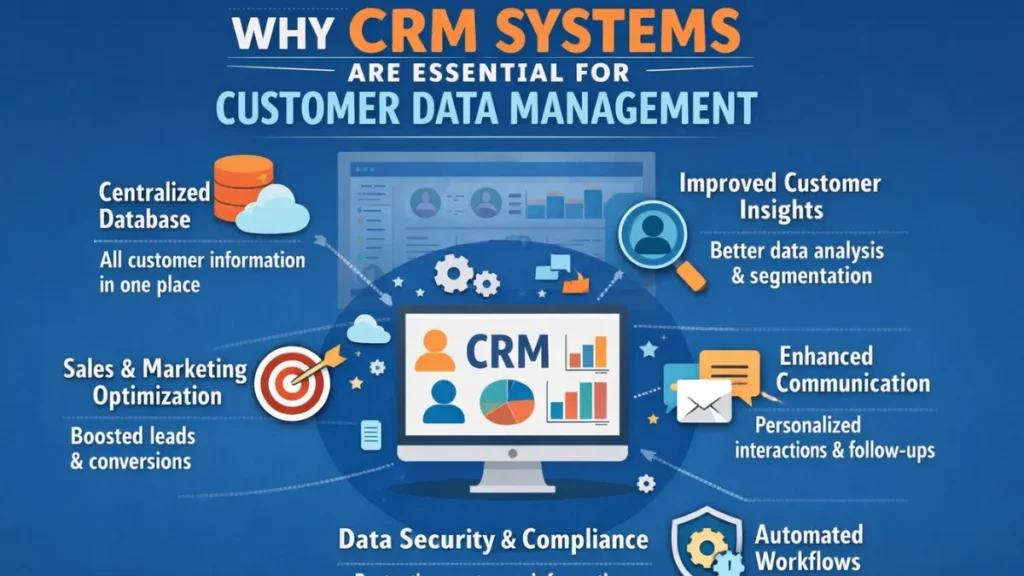
Centralized Customer Data Storage
One Source of Truth
CRM systems eliminate data silos by storing all customer information in a single platform. This means:
- No duplicate records
- No missing details
- No conflicting information
Every team sees the same, updated customer profile, improving accuracy and consistency.
Easy Data Access
Authorized users can access customer data instantly, reducing delays and improving productivity. This is especially important for fast-growing businesses.
Improved Data Accuracy and Quality
Reduced Human Errors
Manual data entry across spreadsheets often leads to:
- Duplicate entries
- Incorrect details
- Outdated records
CRM systems automate data collection and updates, ensuring higher data accuracy.
Real-Time Data Updates
Whenever a customer interacts with your business—through email, website, or support—the CRM updates the data automatically, keeping records current.
Better Customer Understanding
360-Degree Customer View
CRM systems provide a complete view of:
- Interaction history
- Buying patterns
- Communication preferences
- Support issues
This helps businesses understand who their customers are and what they need.
Behavior-Based Insights
CRM analytics reveal:
- What customers engage with
- When they are most active
- Which products interest them
These insights help businesses make informed decisions.
Enhanced Data Security and Compliance
Secure Data Storage
CRM systems offer:
- Encrypted data storage
- User access controls
- Regular backups
This reduces the risk of data leaks and unauthorized access.
Compliance with Data Regulations
CRMs help businesses comply with data protection regulations by:
- Managing consent records
- Limiting data access
- Tracking data usage
This builds customer trust and reduces legal risks.
Efficient Data Segmentation and Organization
Smart Customer Segmentation
CRM systems allow businesses to segment customers based on:
- Location
- Purchase history
- Engagement level
- Preferences
Segmentation makes marketing and communication more relevant and effective.
Organized Data Structure
CRM systems store data in structured formats, making it easy to search, filter, and analyze.
Improved Collaboration Across Teams
Sales and Marketing Alignment
With shared access to customer data:
- Marketing teams deliver better-qualified leads
- Sales teams close deals faster
This alignment reduces friction and increases revenue.
Better Customer Support
Support teams can see previous interactions and purchase history, allowing them to resolve issues quickly and professionally.
Automation for Smarter Data Management
Automated Data Capture
CRM systems automatically capture data from:
- Forms
- Emails
- Chatbots
- Marketing campaigns
This saves time and reduces manual work.
Workflow Automation
CRMs automate:
- Follow-ups
- Notifications
- Data updates
Automation ensures no customer data is ignored or forgotten.
Data-Driven Decision Making
Actionable Insights
CRM analytics help businesses:
- Identify trends
- Measure performance
- Forecast demand
Decisions are based on real data, not assumptions.
Improved Business Strategy
Customer data insights influence:
- Product development
- Pricing strategies
- Customer experience improvements
CRM systems turn data into growth opportunities.
Scalability for Growing Businesses
As businesses grow, customer data increases rapidly. CRM systems:
- Handle large data volumes
- Support new users and teams
- Integrate with other tools
This scalability ensures long-term efficiency.
Common Problems Without a CRM
Businesses without a CRM often face:
- Lost customer data
- Poor customer experiences
- Missed follow-ups
- Low customer retention
- Inefficient teamwork
A CRM system solves these issues by bringing structure and visibility.
The Future of CRM and Customer Data Management
Modern CRM systems are evolving with:
- AI-powered insights
- Predictive analytics
- Personalization engines
- Real-time customer tracking
CRMs will continue to play a central role in data-driven business success.
Conclusion
CRM systems are essential for customer data management because they bring organization, accuracy, security, and insight to customer information. By centralizing data, improving collaboration, and enabling smarter decisions, CRM systems help businesses build stronger customer relationships.
In a world where customer expectations are constantly rising, businesses that manage data effectively gain a powerful competitive advantage. A CRM system is not just a tool—it is a foundation for sustainable growth.
FAQs
Why is CRM important for managing customer data?
CRM centralizes, secures, and organizes customer data, making it easier to use and analyze.
Can small businesses benefit from CRM systems?
Yes, CRM systems help small businesses improve efficiency, customer experience, and data accuracy.
How does CRM improve data security?
CRM systems use encryption, access controls, and backups to protect customer information.
Is CRM useful for non-sales teams?
Yes, CRM systems support marketing, support, and management teams.
Does CRM help with customer retention?
Absolutely. Better data management leads to personalized experiences and stronger customer relationships.